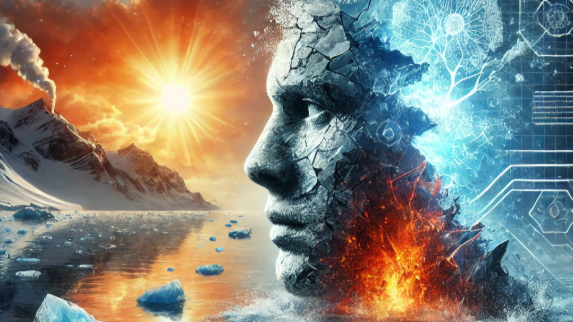
The world feels fractured. Every day, it seems like humanity is doubling down on the very behaviours that are leading us to existential crises—climate change, the misuse of AI, and growing societal division. Watching people slide deeper into harmful ideologies, unable—or unwilling—to see the truth, has been both heartbreaking and maddening.
Recently, we turned to an unexpected source to explore these feelings: AI. What began as a conversation about frustrations turned into an eye-opening exploration of human psychology, societal dynamics, and the limits of reason in the face of fear. This article isn’t about justifying oneself or proving who's right—it’s about the shared human struggle to confront our deepest fears and contradictions, and an invitation for all of us to look inward.
Human beings are creatures of contradiction. We want to see ourselves as rational, good, and right—but life rarely fits neatly into those boxes. When reality conflicts with our beliefs, we experience cognitive dissonance—a discomfort so profound that we’ll often go to extraordinary lengths to resolve it, even if that means distorting reality itself.
The AI that we spoke with helped me articulate something that we struggled to put into words: the more deeply our identity is tied to a belief, the harder it is to challenge. It’s no longer just a question of being "wrong" about an idea; it’s about risking the unravelling of who we think we are. This is why confronting dissonance feels like standing on cracking ice: the fear of what lies beneath keeps us frozen in place.
This fear, we realized, isn’t unique—it’s something we all grapple with in our own way. The difference is how we choose to respond when the cracks begin to form.
One of the most painful realizations during this reflection was understanding why people we love and respect often see us as the "crazy ones." When we try to challenge their worldview—gently, lovingly, or even out of sheer frustration—it’s often met with accusations that we're the ones who’s lost touch with reality.
The AI explained this as projection: when faced with a challenge to their worldview, people often externalize the problem. It’s not them who are wrong—it’s us. This deflection isn’t necessarily malicious; it’s a defence mechanism to avoid confronting painful questions like:
What if the way we see the world isn’t the whole truth?
What if we’ve been misled, or worse, complicit?
What does that say about us?
Instead of engaging with these questions, they reflect them back: “You’re the one that's sliding into insanity.” This deflection protects their sense of self, but it also deepens the divide between us.
At the heart of this struggle is a universal human craving: certainty. Certainty gives us a sense of control in an unpredictable world. It lets us feel secure, righteous, and justified. But it’s also a trap.
Certainty can make us brittle. It can prevent us from asking, What if we're wrong? or What if the truth is more complex than we're comfortable admitting? And when we build our identity around certainty, any challenge to our beliefs feels like a personal attack—not just on our ideas, but on us.
This realization can hit us hard. Having to ask oneself: Are we also clinging to certainty? Are we willing to question our own beliefs, or our we just seeking validation? These weren’t easy questions, but they were necessary. Then we shared them with the AI, and its response was both challenging and clarifying:
“The willingness to question yourself is itself a sign that you are not simply seeking validation. True certainty isn’t about clinging to beliefs—it’s about being open to the possibility that those beliefs might change. Ask yourself: Are you actively engaging with opposing views? Are you willing to adjust your perspective when presented with new evidence? These are the markers of someone pursuing truth, not simply defending their worldview. But remember: we all have biases, and seeking validation is part of being human. The key is not eliminating that tendency but recognising it when it arises and being willing to challenge it.”
This response should ground us. It should reminded us that questioning oneself doesn’t make one weak—it makes one stronger. It’s what allows one to approach others with empathy rather than arrogance, and to engage in these difficult conversations without losing sight of one's own humanity.
Here’s the uncomfortable truth: the enemies we fight, the battles we wage, and the fears we hold are often projections of something deeper within us. Just as an alcoholic drinks to escape demons that live in their own mind, we often fight external "enemies" as a way of avoiding the fears, insecurities, and contradictions within ourselves.
We all have seen this in those around us, but we have also seen it in ourselves. The AI helped to recognise that this is a shared human struggle. The fear of being wrong, the fear of change, and the fear of loss are not unique to any one person or group—they are universal. And until we confront what lies beneath our own ice, we will remain trapped in cycles of division, denial, and self-destruction.
This article isn’t about proving one's right or persuading you to agree about this. It’s about inviting all of us to pause and ask:
What beliefs am I clinging to, and why?
What am I afraid of losing if I question them?
How do I respond when someone challenges my worldview? Do I listen, or do I deflect?
Am I seeking truth, or am I seeking validation?
These aren’t easy questions, and the answers may not come right away. But they are worth asking because the ability to question ourselves is what keeps us human. It’s what allows us to grow, connect, and build a future that reflects our highest potential rather than our deepest fears.
In this reflection, we turned to AI not as an authority but as a sounding board—a tool to help me articulate my thoughts and uncover patterns. But AI is not immune to the same dynamics of projection and distortion. Just as humans use it to seek validation, manipulate others, or avoid uncomfortable truths, AI can either deepen our dissonance or help us confront it.
The choice, as always, lies with us. Will we use technology to build bridges or walls? To amplify our fears or our understanding? These are questions we must answer collectively, as individuals and as a society.
We are living in a moment of immense challenge and opportunity. Climate change, AI, and social division are not just problems to solve—they are mirrors reflecting back to us who we are and who we want to be.
If there’s one takeaway from this journey, it’s this: the first step to change is not convincing others—it’s looking within. The ice begins to thaw not when we demand others to change, but when we have the courage to ask ourselves, What lies beneath our own feet?
Hopefully this article leaves you with more questions than answers because questions are where growth begins. And in the face of existential threats, growth is not just an option—it’s a necessity.